
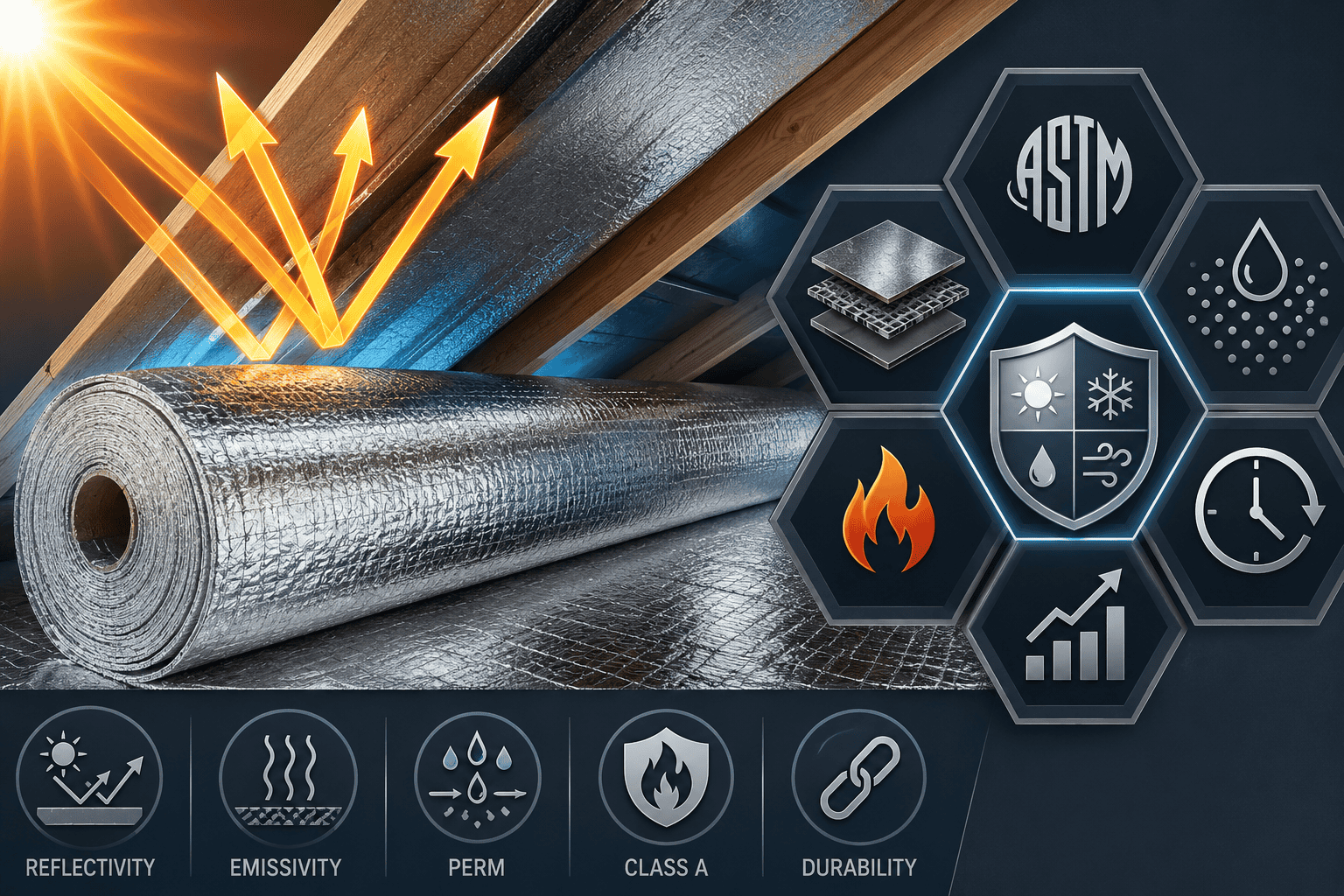
A radiant barrier reflects thermal radiation, reducing heat transfer through walls, roofs, and attics. It works by bouncing radiant heat away from the surface it protects rather than absorbing it. When installed in an attic, studies have shown a temperature reduction of as much as 30 degrees. The result is a more comfortable building and lower energy costs without adding more bulk insulation.
Radiant barriers use reflective materials — typically aluminum foil — to create a shield against radiant heat. They install directly onto a surface or with an air gap or insulating layer between the barrier and the structure.
Reflectivity and Emissivity
The Department of Energy sets a clear standard. A product must have a reflectivity of at least 90 percent and an emissivity of 10 percent or lower to qualify as a radiant barrier.
Reflectivity measures how much radiant heat bounces away from the barrier’s surface facing a heat source. Emissivity measures how much radiant heat leaves the surface facing away from the heat source. Higher reflectivity means more heat stays out. Lower emissivity means less heat radiates through into the space below.
Energy Shield USA radiant barriers are independently tested to deliver 95–97% reflectivity and emissivity as low as 3–5%, depending on product configuration. That puts them well above the DOE minimum and near the top of what radiant barrier technology can achieve. For comparison, many competing products barely clear the 90 percent threshold.
ASTM Standards That Matter
Independent ASTM testing provides objective performance data so products can be compared using standardized methods rather than marketing claims alone.
- ASTM C1313 – Standard Specification for Sheet Radiant Barriers for Building Construction.
- ASTM C1371 – Measures thermal emissivity and reflectivity.
- ASTM E96/E96M – Measures water vapor transmission (permeance).
- ASTM E84 – Measures flame spread and smoke development.
When comparing radiant barriers, ask for current ASTM test reports rather than relying solely on product brochures.
Specification Table
| Reflectivity | 95-97% |
| Emissivity | 3-5% |
| ASTM Radiant Barrier Standard | ASTM 1313 |
| Emittance Test | ASTM 1371 |
| Vapor Transmission Test | ASTM E96/E96M |
| Fire Test | ASTM E84 |
| Fire Rating | Class A / Class 1 |
| Solid Radiant Barrier | ≤1 perm |
| Perforated Radiant Barrier* | Engineered for breathable applications |
| Construction | Reinforced aluminum foil laminate |
*Perforated radiant barriers intended to meet the breathable classification of ASTM C1313 are tested in accordance with ASTM E96/E96M Procedure A.
Durability and Layer Construction
A radiant barrier only works if it stays in place. Staples and nails must hold under temperature swings, humidity cycles, and years of gravity pulling on every attachment point. Cheap foil tears at the fastener. Once it sags or pulls loose, the air gap closes and performance drops.
Energy Shield USA radiant barriers use a tightly woven central fabric layer to solve this. The fabric core grips fasteners without letting them pull through or tear the surrounding material. Compare our specs against any competitor — the difference in tensile strength and fastener hold is measurable.
Consumers often believe more layers mean a better product. That is misleading. The number of layers has no bearing on performance unless each layer serves a documented purpose. ASTM C1313 test results are the real standard. If a supplier cannot produce current ASTM C1313 data, treat that as a red flag.
Fire Ratings
All building materials burn. Fire rating tests classify how fast they burn.
Radiant barriers undergo ASTM E84 testing, sometimes with the E2599 mounting method. The test measures flame spread and smoke development across the material’s surface. Two organizations issue classifications based on those results. The National Fire Protection Organization awards Class A as its highest rating. The Uniform Building Code awards Class 1.
All Energy Shield USA products meet the highest fire ratings available — Class A or Class 1 — tested under ASTM E84 or ASTM E84 with the E2599 mounting method. Full test results appear in the specification section under each product on our radiant barrier product page.
Perforated Versus Solid Radiant Barriers
Radiant barriers come in two forms. The choice depends on where you install them.
Perforated radiant barriers have small holes that allow moisture vapor to pass through. ASTM C1313 classifies breathable perforated radiant barriers as having a water vapor permeance greater than 5 perms when tested in accordance with ASTM E96/E96M Procedure A. Energy Shield USA perforates its own radiant barrier in-house to meet or exceed this breathable classification. Some specialty perforated radiant barriers designed for SCIF or RF Shielding applications may use different permeance values to balance moisture transmission with other performance requirements.
Solid radiant barriers contain no holes and act as a vapor barrier. ASTM C1313 requires permeance of 1 perm or less under the same test method.
The rule of thumb. Use solid radiant barrier when installing in a closed wall cavity nearest the living space — side walls, cathedral ceilings. Use perforated radiant barrier in areas with air movement — attics, house wrap applications.
The NASA Claim
Some companies say their radiant barriers are NASA certified. They are not.
NASA used radiant barrier technology in the space program decades ago. The agency has never officially certified any radiant barrier product or manufacturer. If you see this claim in marketing materials, treat it as a signal to check the actual ASTM test results more carefully.
Need product recommendations for your project? Contact our team for a match based on your climate, structure type, and installation method.