

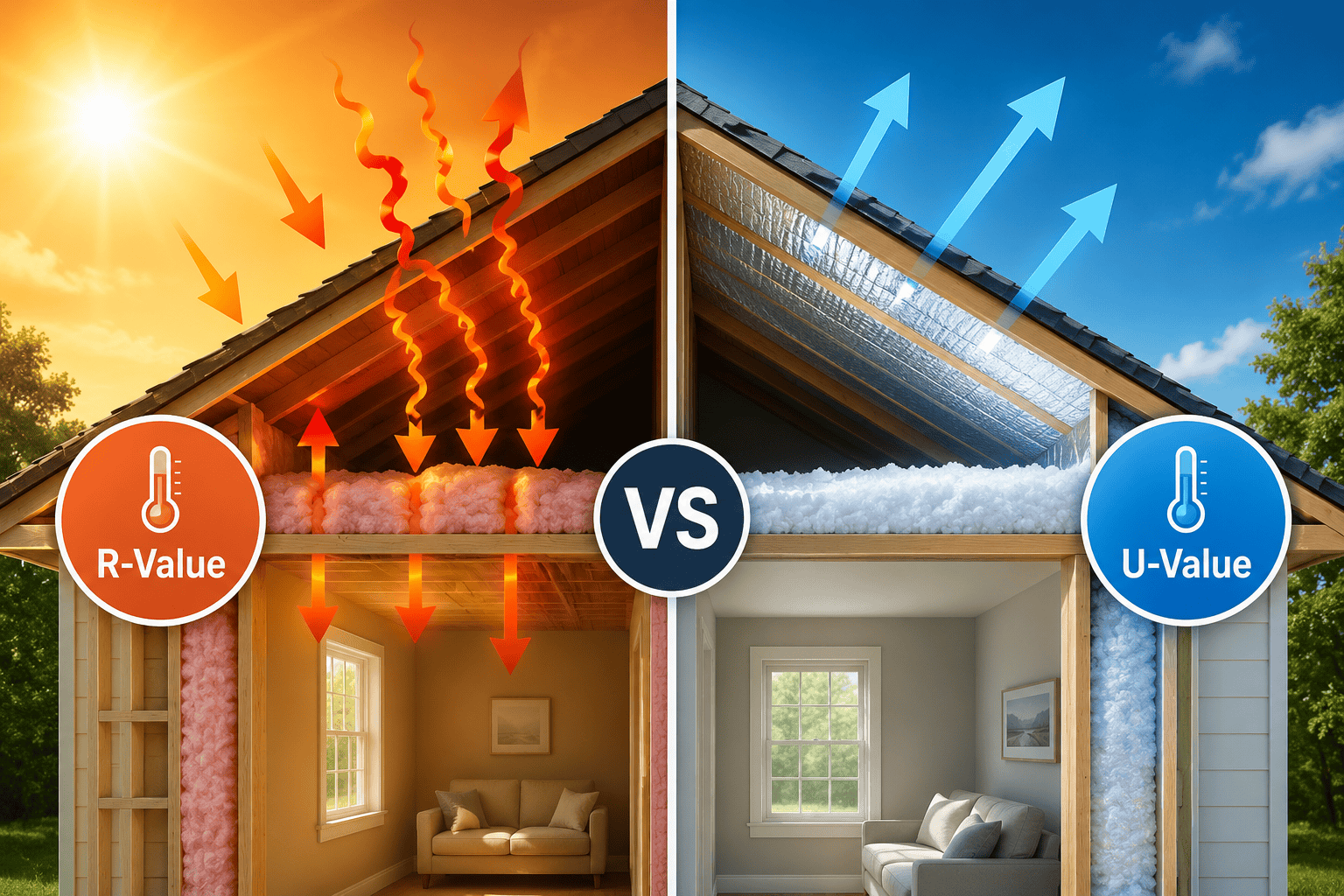
Most people shopping for insulation fixate on R-value. It is the number printed on every batt, roll, and panel at the home improvement store. But R-value tells only half the story. U-value measures how much heat actually escapes through a finished assembly — walls, roof, floor — not just a single material in a lab. If two homes use insulation with the same R-value and one costs less to cool, the difference comes down to U-value.
This guide explains both metrics, how they relate, and why reflective insulation improves building performance in ways R-value cannot capture.
What U-Value Measures
U-value is thermal transmittance. It measures the rate heat moves through a complete building component — a wall, a roof, or a floor. The number accounts for every layer: drywall, sheathing, insulation, siding, air films, and any gaps between them.
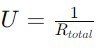
The formula is straightforward. U equals one divided by R-total. R-total is the sum of thermal resistance values for all layers plus surface resistances on both sides. A lower U-value means less heat escapes. A wall with U-0.20 loses half the heat of a wall with U-0.40.
U-value matters because buildings are not built from single materials. They are assemblies. Fiberglass batts might test at R-19 in a lab, but once compressed behind wiring, cut around outlet boxes, and exposed to attic airflow, the assembly U-value tells a different story than the label promised.
Building codes in colder climates often mandate maximum U-values rather than minimum R-values for this reason. The code cares about how the entire wall performs, not how one layer performed on a test bench.
What R-Value Measures
R-value measures thermal resistance. It tells you how well one material resists conductive heat flow. The higher the number, the more resistance. Fiberglass batts range from R-11 to R-38. Spray foam hits R-6 to R-7 per inch. Reflective foil, tested alone for conductive resistance, posts a low R-value — often under R-1.

That low number causes confusion. People see R-1 and assume foil does nothing. The mistake is treating R-value as the only metric that counts.
R-value testing happens in a guarded hot box with still air on both sides. The material faces a temperature difference, and sensors measure heat flow from the hot side to the cold side. This captures conduction. It does not capture radiant heat transfer, which accounts for most of the heat gain in an attic on a summer day. It also ignores air movement, moisture, and installation sloppiness — all of which degrade real-world performance.
R-value is useful for comparing batts to batts or rigid foam to rigid foam. It is less useful when comparing different types of insulation that work on different principles.
The Real Difference Between U-Value and R-Value
R-value is an input. U-value is the output.
Think of U-value as the final score. R-values of each material are the individual stats. You can stack high R-value layers and still get a mediocre U-value if you ignore thermal bridging, air leakage, or radiant heat. A metal stud wall packed with R-19 batts can perform worse than a thinner wall with continuous insulation because the studs conduct heat around the batts. A U-value calculation catches this. An R-value spec does not.
The two numbers are inverses. U equals one divided by R for a single material. But for a whole roof assembly, U equals one divided by the sum of every layer — insulation, drywall, air film, sheathing, and roofing. Every layer contributes, and so do the spaces between them.
Here is a practical example. An uninsulated attic floor might have a U-value near 1.0. Although adding R-30 fiberglass reduces conductive heat flow, it does not prevent the roof deck from radiating heat into the attic. Standard U-value calculations also do not fully capture the reduction in radiant heat transfer provided by a properly installed radiant barrier across an attic air space. That is why reflective insulation can improve real-world cooling performance beyond what R-value or conventional U-value calculations alone might suggest.
For a deeper look at how different materials handle real attic conditions, read our radiant barrier versus fiberglass comparison.
How Reflective Products Change the Equation
Radiant barriers and reflective insulation tackle heat transfer that R-value testing ignores. They reflect radiant heat rather than slowing conductive heat flow.
Energy Shield’s radiant barrier foil reflects up to 97 percent of radiant heat. When stapled to the underside of roof rafters, it sends the sun’s heat back toward the roof deck instead of letting it radiate into the attic. The attic air temperature drops. The insulation on the attic floor faces a smaller temperature difference. Less heat pushes into the home. The air conditioner runs fewer cycles.
This is why reflective products post low R-values but deliver real energy savings. The R-value test does not measure radiant performance. It is the wrong yardstick. Energy Shield USA’s reflective bubble insulation pairs a radiant barrier surface with polyethylene bubble layers that add thermal break properties. Reflective foam insulation combines a reflective face with closed-cell foam for both radiant reflection and conductive resistance. Neither product shines on an R-value chart alone. Both reduce the effective U-value of the roof or wall assembly by cutting radiant heat transfer — a variable the R-value score never touches.
Our guide to why attic temperature matters explains how even a 20-degree drop can cut cooling costs noticeably. You can also run your own numbers with the radiant barrier savings calculator.
Which Metric Should You Use
For meeting building code, check the required R-value for your climate zone. That is the legal minimum, and inspectors will verify it.
For understanding how your home will actually perform, pay attention to U-value. It gives you the assembly-level picture that R-value cannot. If you are building new or doing a major renovation, ask your contractor for U-value calculations on walls and roof assemblies. The software exists. Most builders just don’t run it unless asked.
If you are upgrading an existing attic in a warm climate, don’t get stuck on R-value alone. A radiant barrier added to your current insulation often delivers a faster payback than adding more fiberglass. The R-value of the fiberglass doesn’t change. The U-value of the entire ceiling assembly drops because radiant heat is no longer part of the load.
Measure your attic, pick your strategy, and use our insulation square footage calculator to estimate how much product you need.
Conclusion
Every home is different. Climate, roof color, existing insulation, and air sealing all affect which upgrade makes sense first. Our team can recommend products matched to your specific project. Start with a measurement, run a savings estimate, and build from there.