

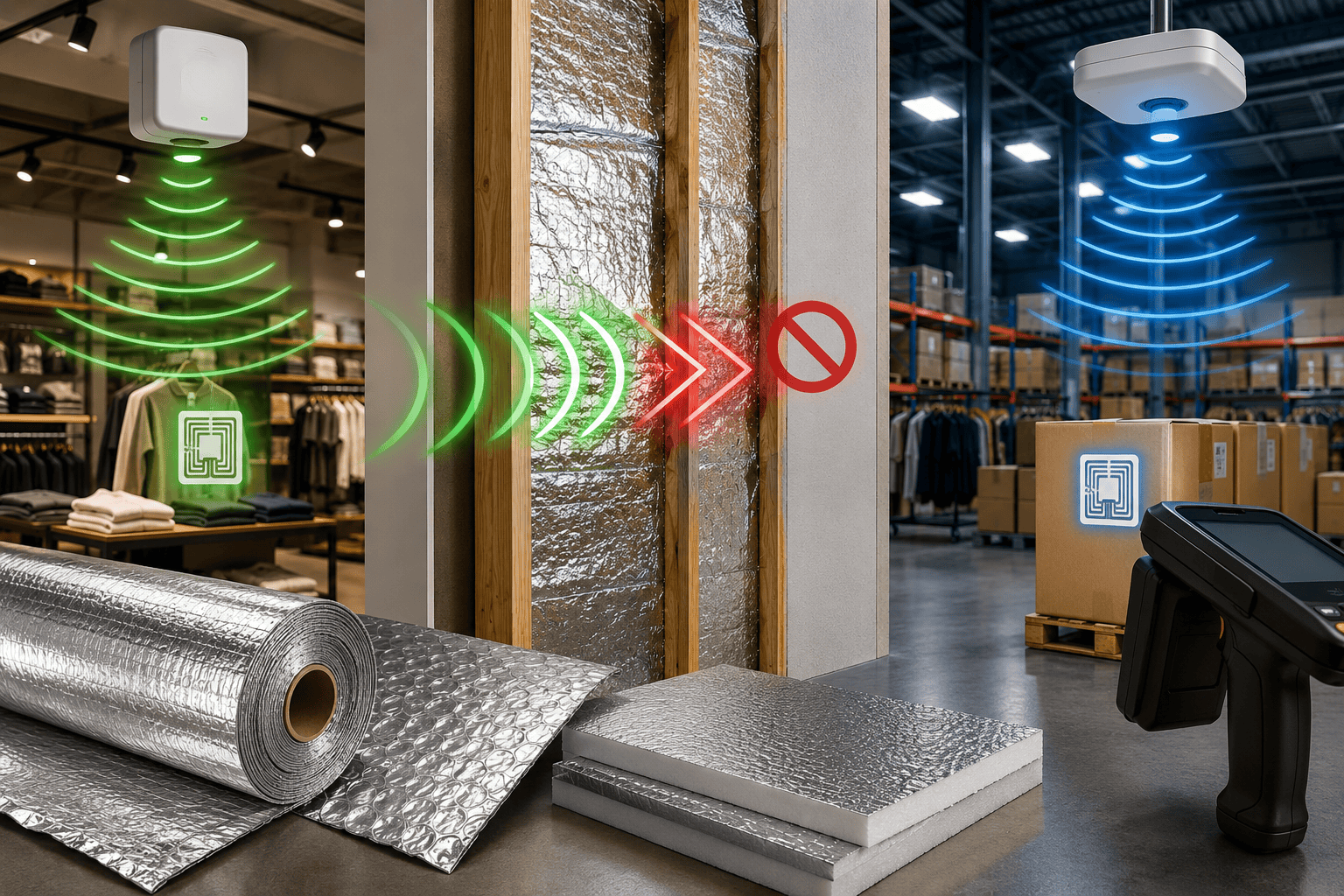
RFID inventory tracking is fast, automated, and widely adopted across retail, warehousing, and logistics. But it has one persistent headache: signal bleed-through. RFID signals pass through walls — especially in malls, shared commercial spaces, and dense warehouses — and when a reader in Store A picks up tags from Store B, inventory counts turn unreliable fast.
Reflective insulation solves this. The same aluminum foil that reflects radiant heat also blocks and controls radio frequency signals, keeping RFID reads contained to their intended zone. No signal escape. No cross-interference. Just accurate inventory data.
How Reflective Insulation Controls RFID Signals
Energy Shield USA reflective insulation products use layers of aluminum foil to interact with both thermal energy and radio frequency signals. The foil reflects RFID waves rather than letting them travel through walls, ceiling cavities, or shared partitions.
Different products fit different applications.
- ES® Radiant Barrier uses highly reflective foil surfaces to handle large wall and ceiling applications. It covers broad areas at a lower material cost while still blocking signal transmission between zones.
- ES® Reflective Bubble combines polyethylene bubble layers with reflective foil. It provides thermal insulation and RFID signal control in a single lightweight roll, making it practical for partition walls in retail and warehouse build-outs.
- ES® Reflective Foam pairs a solid foam core with reflective facings. It adds durability, higher insulation value, and structural stiffness — useful in industrial settings where walls take abuse and signal containment matters.
All three products create a barrier that limits RFID signal travel. Readers capture only the tags inside their designated area.
For more on how reflective materials handle radio frequencies across different applications, read our RF shielding reflective insulation guide.
Benefits for Inventory Tracking
Reflective insulation products—including reflective bubble, radiant barriers, and reflective foam—provide several key benefits:
- Most accurate inventory counts
Signal containment stops misreads between adjacent areas. Your system logs what is actually in the room, not what is in the store next door. - Works across product types
Bubble insulation, radiant barriers, and reflective foam each handle different budgets, performance needs, and installation conditions. - Lower cost than dedicated RF shielding
Reflective insulation installs like standard building material — staple it up, and it works. No specialized panels, no ground straps, no RF engineering required. - Thermal performance comes standard
You get heat reflection and cold protection at the same time. One material does two jobs. - Durability and Longevity
Lightweight yet strong materials designed for long-term performance. - Clean finishes for exposed areas
ES® Single Bubble White provides a finished look that works in visible interior applications where standard foil would feel industrial.
Where to Use It
Reflective insulation can be used in a variety of environments to improve RFID system performance:
- Retail and Shopping Centers
Shared walls between stores are the main culprit for RFID bleed. A layer of reflective insulation inside those partition walls keeps each store’s inventory data isolated. - Warehouses and Distribution Centers
Large open floors often run multiple RFID zones. Reflective barriers between sections prevent one zone’s reads from contaminating the next. - Trucks, Trailers, and Cargo Containers
Mobile RFID tracking needs the same containment as fixed sites. Reflective insulation lines cargo areas to keep scans accurate in transit. - Industrial Facilities
Factories with multiple lines, separate work cells, or adjacent storage areas can isolate each RFID system without building hard-walled rooms.
For high-security applications that need complete RF isolation, see our guide to radiant barriers and SCIF security.
Your next step
Every facility layout is different. Wall materials, reader placement, and tag type all affect how much signal containment you need. Call or email us here with your floor plan or a description of the space. Our team can recommend the right product and coverage strategy.