

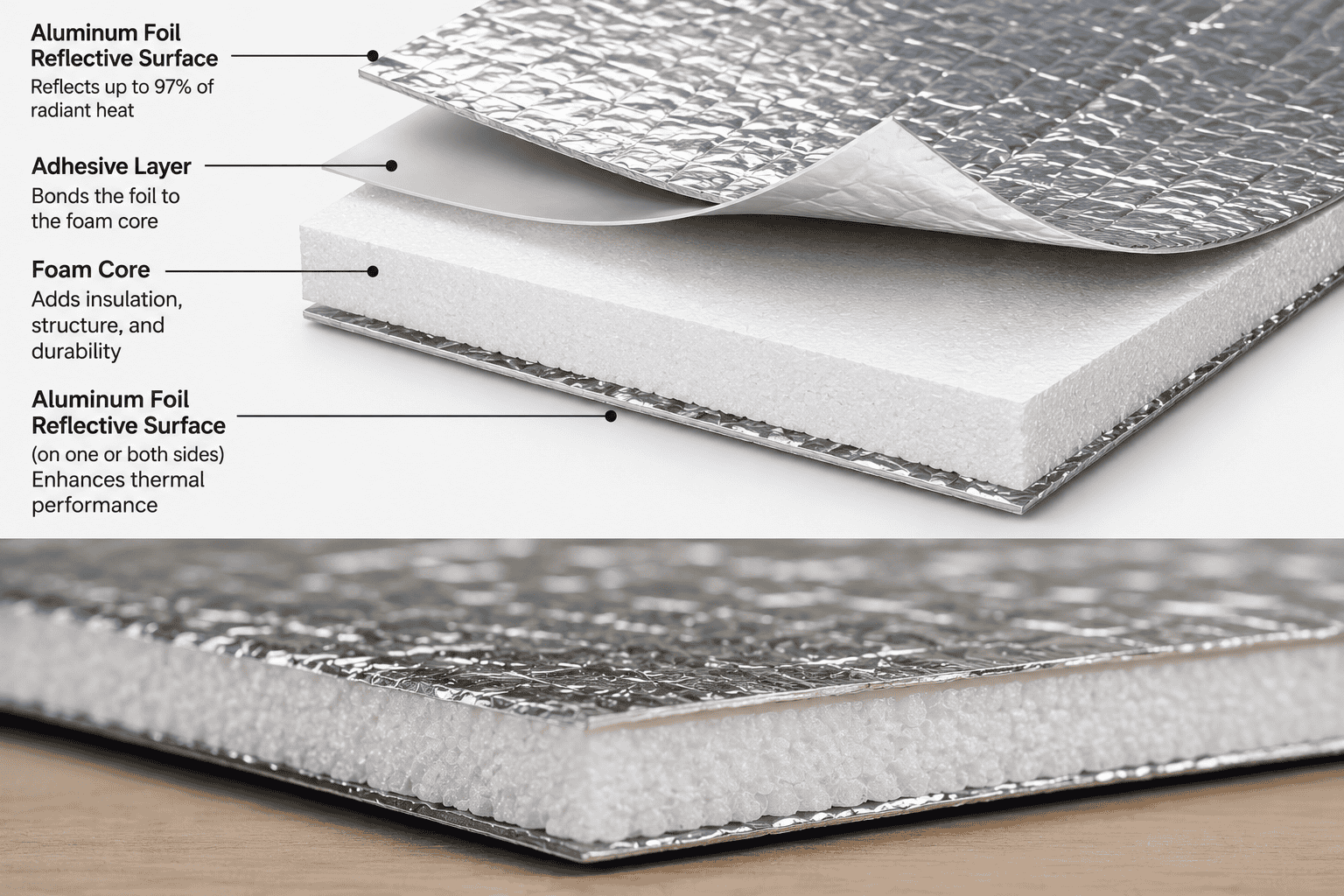
Reflective foam, also called reflective foam core, combines a foam core with a reflective surface, usually aluminum foil. The reflective layer blocks radiant heat while the foam core adds insulation and structure. The result is a material that is strong, durable, and effective at reducing heat transfer in a way mass insulation alone cannot.
What Are the Benefits of Reflective Foam?
- Easy to install. It cuts and shapes to fit tight spaces, and it is light enough for one person to handle without special tools.
- Reduces heat transfer in both directions. It keeps surfaces cooler in summer and warmer in winter by reflecting radiant heat, which lowers energy use and keeps a building comfortable year-round.
- Durable. It resists wear and needs no special maintenance to keep working for years.
- Versatile. It works in attics, walls, and floors, and it combines well with other insulation types for even better results.
What Is the R-Value of Reflective Foam?
Foam board typically has an R-value of about 3.0 to 4.0 per inch of thickness. But reflective foam’s real strength is not its foam R-value — it is that the reflective surface also blocks radiant heat, which R-value does not measure.
That distinction matters. R-value only measures resistance to conductive heat flow. A reflective surface stops radiant heat, a different type of heat transfer that a plain foam board lets through. So a reflective foam does two jobs at once: it resists conduction like ordinary foam, and it reflects radiant heat that ordinary foam ignores.
The R-value also depends on how the material is installed. In system testing, our 1/8-inch reflective foam has shown an effective R-value of 17 (ft²·hr·°F/Btu) for downward heat flow with a single 9.25-inch air space. Splitting that air space into two 4.6-inch gaps pushes the result to R-25.
To put those numbers in perspective, the foam core itself contributes only about 1 to 2. The rest comes from the reflective surface and the air space it needs to work. More reflective air spaces mean more reflective performance — which is why the two-gap configuration outperforms the single gap.
The type and thickness of foam, the temperature, and how much air moves around the material all affect real-world results. Actual R-value can vary from the printed number depending on how and where the material is installed. Contact us for help choosing the right one.