
Sensitive Compartmented Information Facilities (SCIFs) require rigorous protection against electronic eavesdropping. Radio frequency (RF) shielding is a critical component of that protection, and radiant barriers have emerged as a practical, code-compliant solution. These multilayer foil assemblies not only block heat transfer but also provide verified RF attenuation, making them a dual-purpose material for government, military, and corporate security projects. This article covers the applicable standards, the performance of specific radiant barrier products, and the installation practices that ensure a secure, lasting shield.
SCIF Shielding Standards: ICD 705 and NSA 94-106
Every SCIF in the United States must comply with Intelligence Community Directive (ICD) 705, which sets minimum security requirements for construction and accreditation. Within that framework, the National Security Agency’s NSA 94-106 specification details the technical criteria for RF shielding. These documents define the zones, materials, and attenuation levels needed to prevent signal leakage. A key player in this process is the Certified TEMPEST Technical Authority (CTTA). The CTTA reviews shielding designs, approves test plans, and verifies that the finished facility meets the required attenuation. For typical SCIFs, the goal is a minimum of 60 dB of RF attenuation across a broad frequency range, though higher values are often required for higher-security compartments. Radiant barriers designed for SCIF use must be tested to these standards at an NSA-approved TEMPEST facility to confirm their performance.
Why Radiant Barriers Work for SCIF RF Shielding
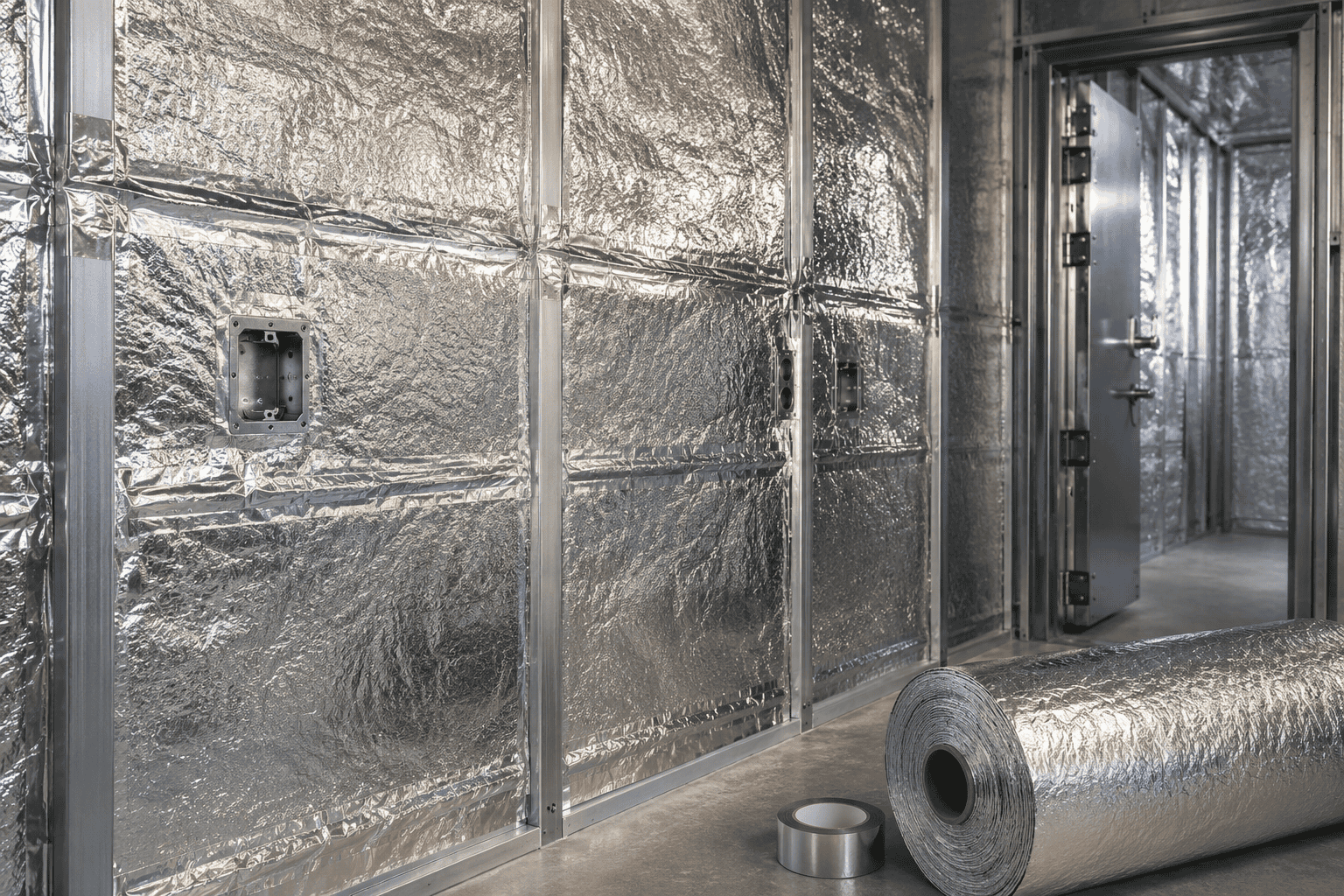
Radiant barriers consist of highly reflective aluminum foil laminated to a reinforcing substrate. In a SCIF, the conductive foil layer reflects incoming RF energy rather than allowing it to pass through walls. When installed correctly with continuous, sealed seams, the barrier creates a conductive envelope that attenuates electromagnetic signals. The same principle that stops radiant heat transfer also blocks radio waves. Because the material is lightweight and flexible, it can be installed inside standard wall cavities, retrofitted into existing structures, or used in new construction without adding excessive weight or thickness. This makes radiant barriers a versatile choice for facilities where traditional metal sheet shielding would be impractical or too costly.
Energy Shield USA SCIF Radiant Barrier Products
Energy Shield USA offers a SCIF-rated radiant barrier specifically engineered for use in secure facility shielding assemblies designed in accordance with ICD 705 and NSA 94-106 requirements. The ES Radiant Barrier is manufactured with two outer layers of 99% pure aluminum foil bonded to a reinforced core for strength and durability. In independent testing conducted at an NSA-approved TEMPEST facility, the product achieved an average RF attenuation of 73 dB across 378 test frequencies, exceeding the 60 dB attenuation level commonly specified for many SCIF applications.
The ES Radiant Barrier is designed for installation within wall, ceiling, and enclosure assemblies where a continuous conductive foil layer is required. Its lightweight construction allows for easy integration into both new construction and retrofit projects while maintaining shielding continuity. The material is also Class A fire rated (ASTM E84 flame spread 15, smoke developed 5) and can function as a vapor retarder when specified as part of the building envelope design.
When properly installed with sealed seams and conductive tape, the ES Radiant Barrier helps create the continuous shielding envelope necessary for effective RF attenuation and secure facility performance.
For detailed specifications and ordering information, visit the RF Shielding product page.
Solid vs. Perforated SCIF Radiant Barriers
Choosing between solid and perforated foil is a key decision that affects moisture control. The following table compares the two versions based on manufacturer data:
Property | Solid Version | Perforated Version |
|---|---|---|
| Thickness | 9 mil (0.009 inch) | 9 mil (0.009 inch) |
| Water vapor permeance (ASTM E96) | Less than 1.0 (vapor barrier) | 2.69 (vapor permeable) |
| Average RF attenuation (0–18 GHz, 378 frequencies) | 73 dB | 73 dB |
| Emissivity | 0.03 | 0.03 |
| Flame spread / smoke developed (ASTM E84) | 15 / 5 (Class A) | 15 / 5 (Class A) |
The solid version is chosen when a complete vapor barrier is required, such as in humid climates where moisture migration into the wall cavity must be prevented. The perforated version allows water vapor to pass through, reducing condensation risk in assemblies that need to breathe. Both deliver identical RF shielding performance, so the selection depends on the building envelope’s moisture strategy.
Installation Best Practices for SCIF RF Shielding
Proper installation is critical to achieving the rated attenuation. Any gap, tear, or unsealed penetration will compromise the shield. The recommended method begins with stapling the radiant barrier to the faces of wall studs or ceiling joists. All seams must overlap by at least two inches and be sealed with SCIF-approved conductive tape. Where the barrier meets electrical boxes, conduits, or other penetrations, the foil must be cut precisely and taped completely around the opening. When installing on solid surfaces such as concrete or drywall, a spray adhesive designed for foil bonding is used, followed by full tape sealing at all edges. After installation, the CTTA will typically perform a continuous wave sweep to verify there are no leaks above the acceptable limit. Attention to detail during the racking, taping, and trimming phases directly determines whether the final facility passes its accreditation test.
Real-World SCIF Applications
Energy Shield USA SCIF radiant barriers are specified for a range of sensitive facilities. Government intelligence centers use them to secure spaces where classified information is processed or discussed. Military command posts require shielding in both permanent buildings and deployable shelters. Corporate secure rooms, such as those used for proprietary research or legal strategy, also benefit from the same tested materials. In each case, the lightweight nature of the foil barrier allows it to be installed in existing structures without major structural modifications. This makes it a practical option for retrofitting older SCIFs that need to meet updated ICD 705 requirements. Contractors and security integrators value the consistent performance and the ease of inspection afforded by the visible foil layer.
Frequently Asked Questions
How does a radiant barrier compare to copper mesh or aluminum panels for SCIF shielding?
Radiant barriers such as Energy Shield USA’s SCIF-rated products offer a lighter, more flexible alternative that can be installed inside standard wall cavities. They achieve the same 73 dB average attenuation as many metal panel systems but at a lower installed cost and with less structural impact. Copper mesh is still used for certain retrofit applications, but foil barriers provide a continuous, testable shield with fewer joints to seal.
Does the radiant barrier require an air gap to function as RF shielding?
The RF shielding performance of these products does not rely on an air gap. The 99% pure aluminum foil acts as a conductive enclosure regardless of adjacent materials. However, when the same product is also used as a thermal radiant barrier, an air gap of at least 3/4 inch on the reflective side is recommended for maximum heat reflection. For SCIF applications, the air gap requirement is driven only by the thermal design, not the RF requirement.
Can I install the barrier myself, or must a certified contractor do it?
While the material can be installed by a skilled DIYer, SCIF accreditation requires that installation be performed or supervised by personnel approved by the CTTA. The final shielding effectiveness must be tested and certified. If you are a contractor working on a SCIF, you should coordinate with the facility’s security office to ensure your installation methods meet the approved plan. For non-SCIF commercial RF shielding, self-installation is acceptable.
What is the lifespan of an ES Radiant Barrier in a SCIF wall assembly?
When installed correctly and not exposed to physical damage or moisture, the foil and reinforcement layers last the life of the building. The aluminum does not rust, and the Kraft paper and fiberglass core are stable under normal conditions. The Class A fire rating and low smoke development ensure it meets building code requirements for concealed spaces. Periodic inspections during security reviews will confirm the integrity of seams and sealant.
For complete technical data and to order Energy Shield USA radiant barriers for your SCIF project, visit the RF Shielding product page.