
Radiant barriers have improved building efficiency for years, but misconceptions still persist about how they work and where they help. In part two, we take on a few more common myths and give you the facts behind them.
MYTH: Radiant barriers only work when the sun is shining
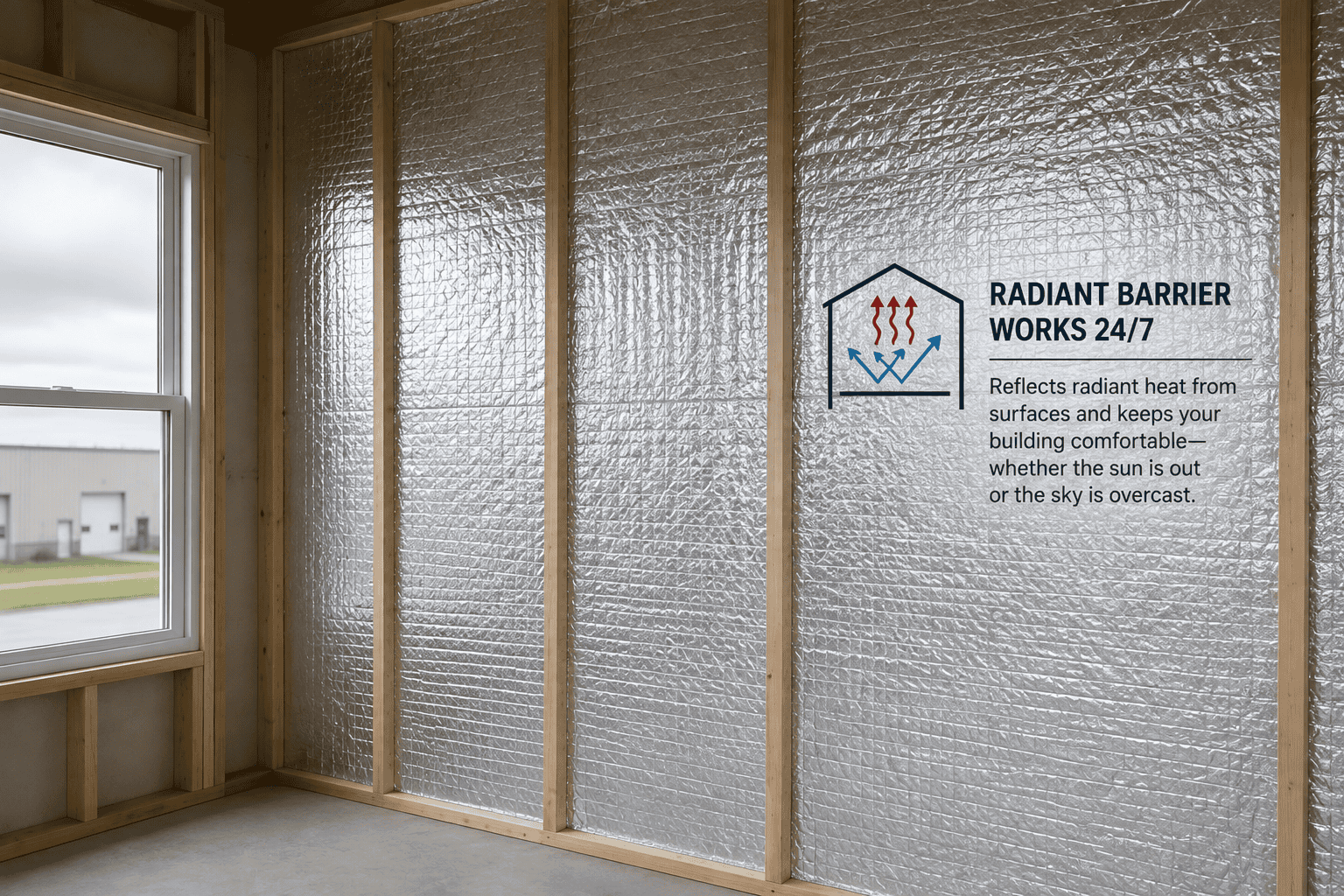
FACTS: They cut heat transfer whether or not the sun is out.
Yes, radiant barriers reflect the sunlight that hits a roof and tries to work its way down into your living space. But the sun is not the only source of radiant heat. Even on cloudy days, surfaces in and around a building are constantly emitting and absorbing thermal radiation, and a radiant barrier reflects that too. The mechanism does not switch off when the sun goes behind a cloud — so the savings do not either.
MYTH: Radiant barriers are only for homes
FACTS: They work in commercial, industrial, agricultural, and data center buildings too.
In commercial buildings, radiant barriers cut heat gain through roofs and walls, which lowers cooling costs and improves comfort for tenants and employees.
In industrial facilities, that same heat reduction keeps workspaces cooler. That means more comfortable conditions, better productivity, and a lower risk of heat-related illness — plus less energy spent cooling the facility.
Data centers are a specialized case worth calling out. The single biggest operating cost of a data center is removing the heat its servers generate, around the clock, year-round. A radiant barrier on the structure helps keep outside heat from adding to that load, which reduces the cooling demand and the energy bill. In an environment where a few degrees of efficiency means real money, that reflected heat is a cheap, passive way to buy back capacity.
Agricultural buildings are where the benefits add up fastest. A radiant barrier on the roof or walls reflects summer heat away, keeping animals and workers cooler. In winter, it reflects heat back in, cutting heating costs. It also reduces moisture buildup, which matters in barns and sheds where condensation can lead to mold that harms animals and crops. A more consistent temperature means less moisture and a healthier building overall.
MYTH: Radiant barriers only make sense in new construction
FACTS: They are just as cost-effective for buildings that already exist.
Radiant barriers install directly onto existing surfaces — attics, walls, floors — without major renovation or structural changes. The materials are lightweight and easy to cut and shape around ductwork and pipes, so installation is quick and minimally disruptive to whoever is using the building. You do not need to tear anything apart to get the benefit.
MYTH: Radiant barriers only work alongside other insulation
FACTS: They deliver real savings on their own.
Pairing a radiant barrier with fiberglass or cellulose does improve results, especially in colder climates where you want to hold heat in. But a radiant barrier does not need that extra layer to work. It reflects thermal radiation — a major source of heat transfer that conventional insulation only slows — and it is most effective during the hottest part of the day, exactly when fiberglass and cellulose are least effective. So even installed alone, a radiant barrier cuts the heat that enters or leaves through your roof, walls, and floors.
Radiant barriers are a versatile, weather-independent solution for any building type. Understanding what they actually do — beyond the myths — is what lets you use them where they pay off most.